Health & Safety Policy for Commercial Waste Removal Croydon
Scope: This policy defines the health and safety commitments and procedures for commercial waste removal and commercial rubbish removal operations within our service area. It applies to all staff, contractors and third parties involved in commercial waste collection, transfer and disposal activities. The aim is to minimise risk, protect workers and the public, and ensure compliance with applicable statutory requirements relevant to commercial waste services. All personnel must read, understand and follow this policy before undertaking any task.Organisational Responsibilities
The company director and senior management retain overall responsibility for health and safety performance. Operational managers and supervisors are responsible for day-to-day implementation, including ensuring that risk assessments are carried out and that safe working methods are enforced. Employees have a duty to take reasonable care for their own safety and that of others and to report hazards, incidents or near misses promptly. Clear lines of accountability are maintained to ensure tasks such as site assessments, vehicle checks and waste handling are completed to policy standards.
Risk Assessment and Safe Systems of Work
Before work begins at any commercial site, a documented risk assessment must be completed that identifies hazards associated with bulky waste, hazardous materials, sharps, manual handling and vehicle movement. Control measures include mechanical aids for lifting, appropriate segregation of waste types, safe route planning for collection vehicles and isolation procedures for hazardous loads. A written method statement will accompany higher-risk operations. Regular reviews of risk assessments are mandatory following incidents or changes in service operations.Personal Protective Equipment and Training
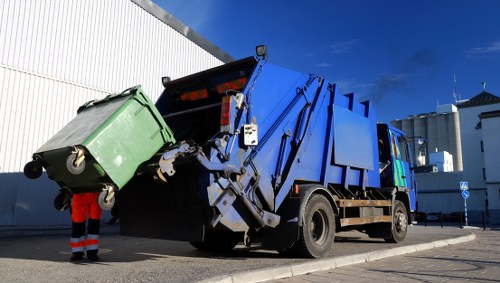
Appropriate PPE must be provided and worn by staff while performing waste collection and removal duties: high-visibility clothing, gloves suitable for the waste type, steel-toe footwear and eye protection where required. Training covers safe lifting techniques, spill response, confined space awareness (where relevant), and correct use of PPE and equipment. Competency records are maintained and refresher training scheduled periodically to ensure ongoing safety and compliance across the rubbish collection team. Operational Controls and Vehicle Safety: Vehicles used for commercial waste collection are subject to routine maintenance, pre-shift inspections and secure load procedures. Drivers and loaders must follow site-specific instructions, observe traffic management plans, and apply exclusion zones during loading and unloading. Fuel, electrical and mechanical hazards are controlled through lock-out/tag-out procedures and permits where necessary. Emergency contact plans are in place for incidents such as spills or fires during transit.
Waste segregation requirements are strictly enforced: recyclable materials, general commercial refuse, controlled waste and hazardous substances are separated at source or upon collection consistent with environmental regulations. Where the rubbish company service area requires, manifest documentation accompanies hazardous consignments and staff receive instruction on document completion and safe transport of controlled waste.
 Incident Reporting, Investigation and Corrective Actions
All incidents, injuries, near misses and dangerous occurrences must be reported immediately and recorded in the company incident log. Investigations are conducted to identify root causes and to implement corrective and preventive actions. Lessons learned are disseminated to teams through toolbox talks and updated safe systems of work. Where applicable, statutory notifications are made in line with legal obligations. The emphasis is on continuous improvement of safety practices and reducing recurrence.
 Health surveillance and wellbeing are provided to staff exposed to specific risks such as repetitive handling or chemical exposure. Occupational health reviews, vaccination programmes where appropriate and access to counselling services form part of the welfare provision. The employer commits to reasonable adjustments for employees returning to work after injury and supports rehabilitation to reduce long-term absence.
Contractors, Subcontractors and Visitors: Third parties engaged to support commercial waste collection must demonstrate competence and adherence to this policy. Contracts require evidence of appropriate insurance, training records and risk control measures. Before attending sites, contractors receive a site induction covering local hazards, emergency procedures and contact points. Visitors are supervised and informed of relevant restrictions, including no-go zones and PPE requirements.
Monitoring and review arrangements include scheduled audits, performance indicators and management reviews. The policy is reviewed at least annually or earlier if changes in operations, legislation or incidents indicate a need. This document forms the core safety statement for our commercial waste and rubbish removal operations across the service area and should be read in conjunction with operational procedures and vehicle safety manuals. Commitment to safety is integral to our service delivery and to protecting employees, customers and the public.